Limitación de tasa
Última actualización: 11 de septiembre de 2026 · Istio 1.31. Ejemplos independientes; elija una política local por carga/listener. Las aplicaciones sidecar usan HTTP 8080 en
default; los gateways seleccionan uno dedicado conistio: ingressgatewayenistio-system. Verifique etiquetas/listeners antes de aplicar. No se desplegaron ni probaron con carga.
La limitación de tasa restringe solicitudes para proteger servicios de sobrecarga, asegurar uso justo y controlar costes.
Índice
- Descripción general
- Tipos
- Limitación local
- Limitación global
- Ejemplos prácticos
- Monitorización
- Resolución de problemas
Descripción general
Se necesita limitación en estas situaciones:
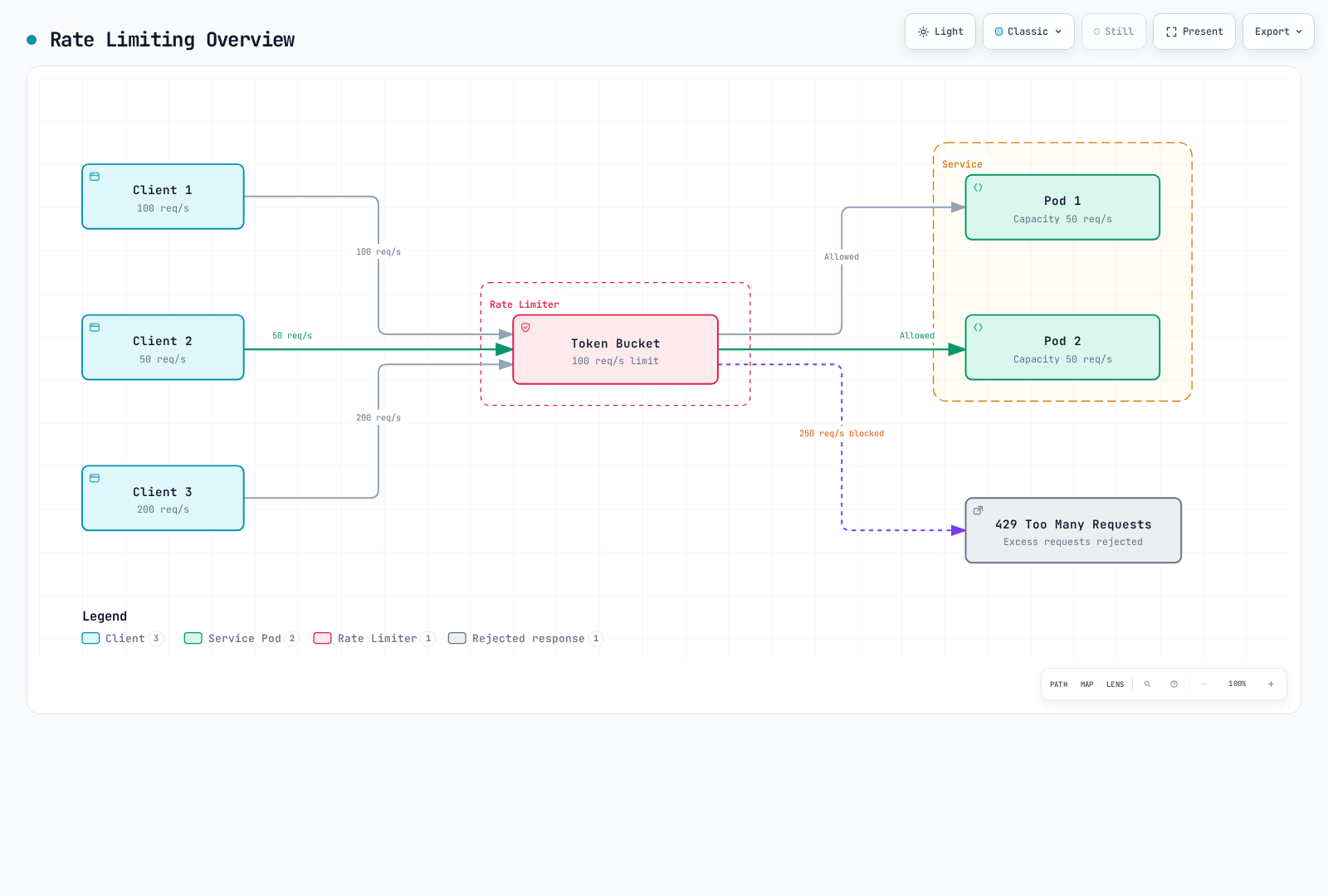
Objetivos
- Protección del servicio: Evitar sobrecarga
- Equidad: Requiere un modelo deliberado de descriptores/identidad; un bucket compartido no implica equidad por cliente.
- Control de costes: Gestionar costes de llamadas a API externas
- Reducir abuso: Limita solicitudes HTTP seleccionadas; no sustituye protección edge/DDoS ni evita agotamiento de conexiones/TLS.
Tipos de limitación
1. Limitación local
Características:
- Cada proxy Envoy limita de forma independiente
- Respuesta rápida sin llamadas adicionales
- En entornos distribuidos, el límite total se aplica por instancia
# 100 req/s limit per pod
# Three independently configured buckets can sustain roughly 300 req/s in aggregate,
# subject to traffic distribution; each bucket also has its own burst allowance.
2. Limitación global
Características:
- Usa servidor centralizado
- Contadores compartidos por dominio/descriptor y ventana; importa el comportamiento de backend/fallo
- Ligera latencia por llamada externa
# Shared descriptor quota:100 per backend second-window
# Replicas must use the same counter; test window boundaries and backend failures.
Comparación
| Característica | Local | Global |
|---|---|---|
| Alcance de cuota | Por bucket local configurado | Dominio/descriptor compartido |
| Rendimiento | Muy rápido | Algo más lento |
| Complejidad | Baja | Alta, requiere servicio externo |
| Uso | Protección general | Control preciso |
Limitación local
Algoritmo token bucket
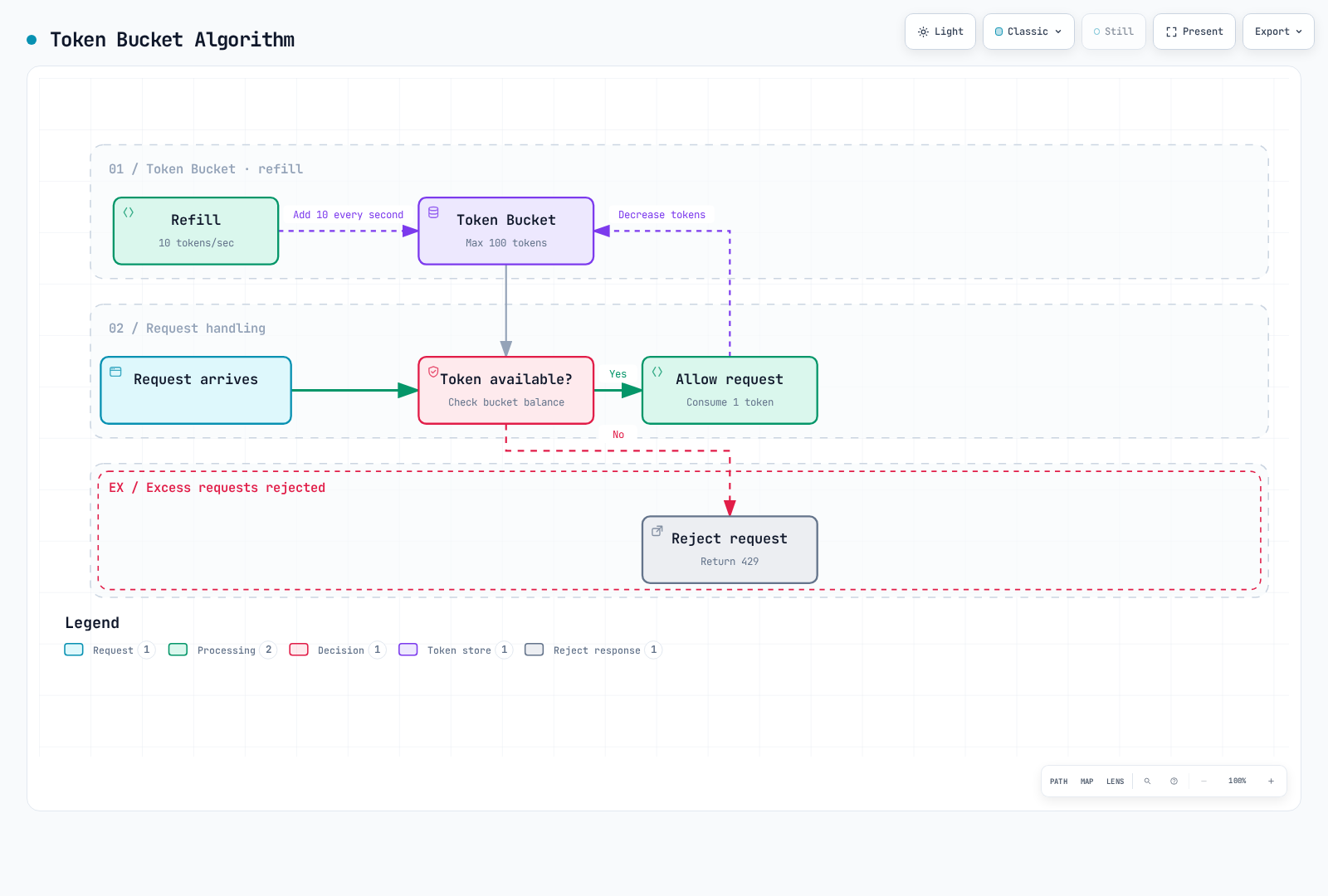
Configuración básica
apiVersion: networking.istio.io/v1alpha3
kind: EnvoyFilter
metadata:
  name: local-ratelimit
  namespace: default
spec:
  workloadSelector:
    labels:
      app: myapp
  configPatches:
  - applyTo: HTTP_FILTER
    match:
      context: SIDECAR_INBOUND
      listener:
        filterChain:
          filter:
            name: envoy.filters.network.http_connection_manager
            subFilter:
              name: envoy.filters.http.router
        portNumber: 8080
    patch:
      operation: INSERT_BEFORE
      value:
        name: envoy.filters.http.local_ratelimit
        typed_config:
          '@type': type.googleapis.com/envoy.extensions.filters.http.local_ratelimit.v3.LocalRateLimit
          stat_prefix: http_local_rate_limiter
          token_bucket:
            max_tokens: 100
            tokens_per_fill: 10
            fill_interval: 1s
          filter_enabled:
            default_value:
              numerator: 100
              denominator: HUNDRED
          filter_enforced:
            default_value:
              numerator: 100
              denominator: HUNDRED
          response_headers_to_add:
          - header:
              key: x-local-rate-limit
              value: 'true'
            append_action: OVERWRITE_IF_EXISTS_OR_ADD
Parámetros principales:
max_tokens: Máximo de tokens del bucket, permite ráfagastokens_per_fill: Tokens añadidos por fill_intervalfill_interval: Intervalo de reposición
Ejemplo:
# 10 requests per second, 100 burst allowed
token_bucket:
  max_tokens: 100
  tokens_per_fill: 10
  fill_interval: 1s

# Result:
# - Average: 10 req/s
# - Burst: up to100 immediately available tokens, not a second sustained rate
Limitación por ruta
apiVersion: networking.istio.io/v1alpha3
kind: EnvoyFilter
metadata:
  name: path-based-ratelimit
  namespace: default
spec:
  workloadSelector:
    labels:
      app: api-service
  configPatches:
  - applyTo: HTTP_FILTER
    match:
      context: SIDECAR_INBOUND
      listener:
        filterChain:
          filter:
            name: envoy.filters.network.http_connection_manager
            subFilter:
              name: envoy.filters.http.router
        portNumber: 8080
    patch:
      operation: INSERT_BEFORE
      value:
        name: envoy.filters.http.local_ratelimit
        typed_config:
          '@type': type.googleapis.com/envoy.extensions.filters.http.local_ratelimit.v3.LocalRateLimit
          stat_prefix: http_local_rate_limiter
          descriptors:
          - entries:
            - key: header_match
              value: /api/v1/users
            token_bucket:
              max_tokens: 1000
              tokens_per_fill: 100
              fill_interval: 1s
          - entries:
            - key: header_match
              value: /api/v1/admin
            token_bucket:
              max_tokens: 100
              tokens_per_fill: 10
              fill_interval: 1s
          filter_enabled:
            default_value:
              numerator: 100
              denominator: HUNDRED
          filter_enforced:
            default_value:
              numerator: 100
              denominator: HUNDRED
          token_bucket:
            max_tokens: 100
            tokens_per_fill: 10
            fill_interval: 1s
          always_consume_default_token_bucket: false
          rate_limits:
          - actions:
            - header_value_match:
                descriptor_value: /api/v1/users
                headers:
                - name: :path
                  string_match:
                    prefix: /api/v1/users
          - actions:
            - header_value_match:
                descriptor_value: /api/v1/admin
                headers:
                - name: :path
                  string_match:
                    prefix: /api/v1/admin
rate_limits genera entradas header_match y descriptors elige buckets coincidentes. El campo existe en la API Envoy fijada por Istio 1.31; aquí sustituye la búsqueda local de acciones de ruta/vhost. Los valores de ruta son claves literales de descriptor; la coincidencia de prefijo real está en headers. Los prefijos también coinciden con rutas más largas que empiezan igual. El bucket fallback limita solicitudes no coincidentes; always_consume_default_token_bucket: false evita limitar adicionalmente usuarios de 100 req/s al fallback de 10 req/s.
Limitación por cabeceras
apiVersion: networking.istio.io/v1alpha3
kind: EnvoyFilter
metadata:
  name: user-based-ratelimit
  namespace: default
spec:
  workloadSelector:
    labels:
      app: api-service
  configPatches:
  - applyTo: HTTP_FILTER
    match:
      context: SIDECAR_INBOUND
      listener:
        filterChain:
          filter:
            name: envoy.filters.network.http_connection_manager
            subFilter:
              name: envoy.filters.http.router
        portNumber: 8080
    patch:
      operation: INSERT_BEFORE
      value:
        name: envoy.filters.http.local_ratelimit
        typed_config:
          '@type': type.googleapis.com/envoy.extensions.filters.http.local_ratelimit.v3.LocalRateLimit
          stat_prefix: http_local_rate_limiter
          descriptors:
          - entries:
            - key: header_match
              value: x-user-tier:premium
            token_bucket:
              max_tokens: 1000
              tokens_per_fill: 100
              fill_interval: 1s
          - entries:
            - key: header_match
              value: x-user-tier:free
            token_bucket:
              max_tokens: 100
              tokens_per_fill: 10
              fill_interval: 1s
          filter_enabled:
            default_value:
              numerator: 100
              denominator: HUNDRED
          filter_enforced:
            default_value:
              numerator: 100
              denominator: HUNDRED
          token_bucket:
            max_tokens: 100
            tokens_per_fill: 10
            fill_interval: 1s
          always_consume_default_token_bucket: false
          rate_limits:
          - actions:
            - header_value_match:
                descriptor_value: x-user-tier:premium
                headers:
                - name: x-user-tier
                  string_match:
                    exact: premium
          - actions:
            - header_value_match:
                descriptor_value: x-user-tier:free
                headers:
                - name: x-user-tier
                  string_match:
                    exact: free
Los descriptores de nivel son buckets compartidos por nivel en cada proxy, no por usuario. Un upstream autenticado debe retirar cabeceras de nivel del cliente e insertar un nivel confiable, y el servicio debe impedir bypass. Niveles ausentes/desconocidos usan fallback acotado. Una cabecera premium sola no autentica.
Limitación global
Consulta un servicio compartido de decisión sobre dominio/descriptor. Puede abarcar réplicas gateway, pero no automáticamente cada solicitud del clúster. Almacenamiento de contadores, límites de ventana, failover y política de fallos afectan la garantía real.
Arquitectura
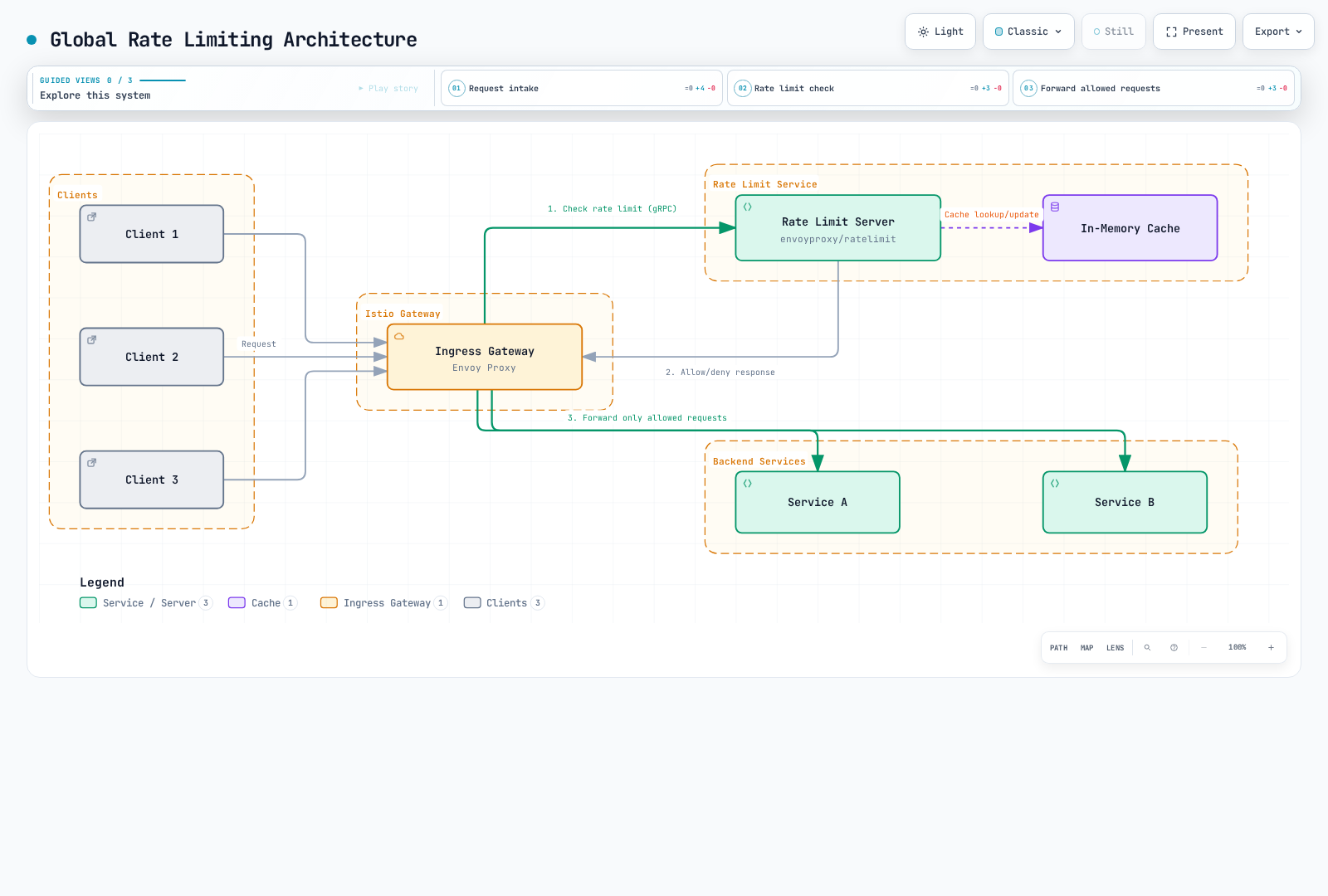
Método de configuración
La limitación global requiere desplegar servicio externo e integrarlo mediante EnvoyFilter.
La caché del diagrama debe respaldarse con contadores compartidos como Redis; cachés independientes en proceso no crean cuota global. El Deployment supone un servicio Redis TCP ya disponible en redis-ratelimit.istio-system.svc.cluster.local:6379 dentro de laboratorio aislado. Aprovisionamiento, autenticación/TLS, persistencia/HA y failover son requisitos separados; no se crea aquí. Configure REDIS_AUTH/REDIS_TLS/certificados del servicio fijado mediante Secrets/montajes apropiados.
La imagen corresponde al commit publicado 8fe6ea42 del 24 de agosto de 2026, fijado por digest de manifiesto y disponible para linux/amd64 y linux/arm64. Upstream usa etiquetas de commit, no releases semánticas posteriores a v1.4.0; no afirma una release productiva/estable certificada. Revise y pruebe actualizaciones. Deployment pide sidecar explícito: verifique selección del injector y acceso gateway a gRPC bajo políticas reales.
1. Desplegar el servicio de límites
Nota: Istio usa envoyproxy/ratelimit como dependencia externa.
apiVersion: v1
kind: ConfigMap
metadata:
  name: ratelimit-config
  namespace: istio-system
data:
  config.yaml: "domain: production-ratelimit\ndescriptors:\n  # Global limit: 100 per second\n  - key: generic_key\n    value: \"global\"\n    rate_limit:\n      unit: second\n      requests_per_unit: 100\n\n  # Per-path limit\n  - key: header_match\n    value: \"/api/v1/*\"\n    rate_limit:\n      unit: second\n      requests_per_unit: 50\n\n  # Per-user limit (per minute)\n  - key: remote_address\n    rate_limit:\n      unit: minute\n      requests_per_unit: 1000\n"
---
apiVersion: apps/v1
kind: Deployment
metadata:
  name: ratelimit
  namespace: istio-system
spec:
  replicas: 1
  selector:
    matchLabels:
      app: ratelimit
  template:
    metadata:
      labels:
        app: ratelimit
      annotations:
        sidecar.istio.io/inject: 'true'
    spec:
      containers:
      - name: ratelimit
        image: docker.io/envoyproxy/ratelimit:8fe6ea42@sha256:a61547259607d40aff153050c2a87873ca1676d1d9f5f06937d412000dcc2df1
        ports:
        - containerPort: 8080
          name: http
        - containerPort: 8081
          name: grpc
        env:
        - name: LOG_LEVEL
          value: info
        - name: CONFIG_TYPE
          value: FILE
        - name: RUNTIME_ROOT
          value: /data
        - name: RUNTIME_SUBDIRECTORY
          value: ratelimit
        - name: RUNTIME_APPDIRECTORY
          value: config
        - name: RUNTIME_WATCH_ROOT
          value: 'false'
        - name: RUNTIME_IGNOREDOTFILES
          value: 'true'
        - name: USE_STATSD
          value: 'false'
        - name: REDIS_SOCKET_TYPE
          value: tcp
        - name: REDIS_URL
          value: redis-ratelimit.istio-system.svc.cluster.local:6379
        - name: HOST
          value: '::'
        - name: GRPC_HOST
          value: '::'
        - name: HEALTHY_WITH_AT_LEAST_ONE_CONFIG_LOADED
          value: 'true'
        volumeMounts:
        - name: config-volume
          mountPath: /data/ratelimit/config
          readOnly: true
        command:
        - /bin/ratelimit
        resources:
          requests:
            memory: 128Mi
            cpu: 100m
          limits:
            memory: 512Mi
            cpu: 500m
        readinessProbe:
          httpGet:
            path: /healthcheck
            port: 8080
          initialDelaySeconds: 5
          periodSeconds: 5
      volumes:
      - name: config-volume
        configMap:
          name: ratelimit-config
---
apiVersion: v1
kind: Service
metadata:
  name: ratelimit
  namespace: istio-system
spec:
  ports:
  - port: 8080
    name: http
    targetPort: 8080
  - port: 8081
    name: grpc
    targetPort: 8081
  selector:
    app: ratelimit
2. Configurar límites globales con EnvoyFilter
apiVersion: networking.istio.io/v1alpha3
kind: EnvoyFilter
metadata:
  name: filter-ratelimit
  namespace: istio-system
spec:
  workloadSelector:
    labels:
      istio: ingressgateway
  configPatches:
  - applyTo: HTTP_FILTER
    match:
      context: GATEWAY
      listener:
        filterChain:
          filter:
            name: envoy.filters.network.http_connection_manager
            subFilter:
              name: envoy.filters.http.router
    patch:
      operation: INSERT_BEFORE
      value:
        name: envoy.filters.http.ratelimit
        typed_config:
          '@type': type.googleapis.com/envoy.extensions.filters.http.ratelimit.v3.RateLimit
          domain: production-ratelimit
          failure_mode_deny: true
          timeout: 0.1s
          rate_limit_service:
            grpc_service:
              envoy_grpc:
                cluster_name: outbound|8081||ratelimit.istio-system.svc.cluster.local
                authority: ratelimit.istio-system.svc.cluster.local
            transport_api_version: V3
3. Añadir acciones al VirtualHost del gateway
Aplique el conjunto una vez al mismo gateway dedicado. Cubre deliberadamente todos sus virtual hosts HTTP; en uno compartido, limite a un vhost generado verificado. Genera descriptores globales, por prefijo y por IP correspondientes al ConfigMap. remote_address es una IP downstream confiable, no identidad de usuario; configure la cadena proxy/XFF real y considere NAT antes de usarla como cuota.
apiVersion: networking.istio.io/v1alpha3
kind: EnvoyFilter
metadata:
  name: filter-ratelimit-actions
  namespace: istio-system
spec:
  workloadSelector:
    labels:
      istio: ingressgateway
  configPatches:
  - applyTo: VIRTUAL_HOST
    match:
      context: GATEWAY
    patch:
      operation: MERGE
      value:
        rate_limits:
        - actions:
          - generic_key:
              descriptor_value: global
        - actions:
          - header_value_match:
              descriptor_value: /api/v1/*
              headers:
              - name: :path
                string_match:
                  prefix: /api/v1/
        - actions:
          - remote_address: {}
El filtro usa el clúster gRPC generado por Istio, con descubrimiento normal y TLS de malla. No añade un clúster manual en texto plano. failure_mode_deny: true normalmente devuelve HTTP 500 ante error de decisión y 429 al exceder límites; false puede permitir ante fallo. El presupuesto 100ms es ilustrativo: alinee timeouts Redis, latencia y plazos del llamante. Pruebe contadores entre ventanas, reinicio/failover Redis y cambios de réplicas. Confirme recarga/reinicio tras cambiar ConfigMap; un Pod Running no prueba política cargada.
Parámetros principales
| Parámetro | Descripción |
|---|---|
domain | Dominio de configuración del servicio, debe coincidir con ConfigMap |
failure_mode_deny | Rechazar o no cuando falla el servicio de decisión |
timeout | Espera de respuesta del servicio |
rate_limit_service | Endpoint gRPC externo |
Criterios para elegir global o local
Usar local:
- Configuración sencilla
- Respuesta rápida
- Sin dependencias externas
- Alcance por bucket; réplicas/distribución afectan throughput agregado
Usar global:
- Límites compartidos para descriptores elegidos
- Reglas complejas por usuario/IP/ruta
- Gestión central
- Requiere servicio externo, con más complejidad
- Pequeña latencia por gRPC
Recomendaciones:
- API Gateway productivo: Global para control preciso
- Protección de microservicios: Local para respuesta rápida
- Híbrido: Global en gateway, local dentro
Ejemplos prácticos
Ejemplo 1: Limitar API Gateway
apiVersion: networking.istio.io/v1alpha3
kind: EnvoyFilter
metadata:
  name: api-gateway-ratelimit
  namespace: istio-system
spec:
  workloadSelector:
    labels:
      istio: ingressgateway
  configPatches:
  - applyTo: HTTP_FILTER
    match:
      context: GATEWAY
      listener:
        filterChain:
          filter:
            name: envoy.filters.network.http_connection_manager
            subFilter:
              name: envoy.filters.http.router
    patch:
      operation: INSERT_BEFORE
      value:
        name: envoy.filters.http.local_ratelimit
        typed_config:
          '@type': type.googleapis.com/envoy.extensions.filters.http.local_ratelimit.v3.LocalRateLimit
          stat_prefix: http_local_rate_limiter
          descriptors:
          - entries:
            - key: header_match
              value: /api/v1/public/*
            token_bucket:
              max_tokens: 100
              tokens_per_fill: 10
              fill_interval: 1s
          - entries:
            - key: header_match
              value: /api/v1/protected/*
            token_bucket:
              max_tokens: 1000
              tokens_per_fill: 100
              fill_interval: 1s
          - entries:
            - key: header_match
              value: /graphql
            token_bucket:
              max_tokens: 500
              tokens_per_fill: 50
              fill_interval: 1s
          filter_enabled:
            default_value:
              numerator: 100
              denominator: HUNDRED
          filter_enforced:
            default_value:
              numerator: 100
              denominator: HUNDRED
          token_bucket:
            max_tokens: 100
            tokens_per_fill: 10
            fill_interval: 1s
          always_consume_default_token_bucket: false
          rate_limits:
          - actions:
            - header_value_match:
                descriptor_value: /api/v1/public/*
                headers:
                - name: :path
                  string_match:
                    prefix: /api/v1/public/
          - actions:
            - header_value_match:
                descriptor_value: /api/v1/protected/*
                headers:
                - name: :path
                  string_match:
                    prefix: /api/v1/protected/
          - actions:
            - header_value_match:
                descriptor_value: /graphql
                headers:
                - name: :path
                  string_match:
                    prefix: /graphql
El ejemplo local clasifica prefijos; /protected no exige autenticación por sí solo. Cada réplica gateway tiene buckets independientes. Rutas desconocidas usan fallback. rate_limits propio evita depender de un nombre de ruta generado adivinado.
Ejemplo 2: Límites por nivel de usuario
apiVersion: networking.istio.io/v1alpha3
kind: EnvoyFilter
metadata:
  name: tiered-ratelimit
  namespace: default
spec:
  workloadSelector:
    labels:
      app: api-service
  configPatches:
  - applyTo: HTTP_FILTER
    match:
      context: SIDECAR_INBOUND
      listener:
        filterChain:
          filter:
            name: envoy.filters.network.http_connection_manager
            subFilter:
              name: envoy.filters.http.router
        portNumber: 8080
    patch:
      operation: INSERT_BEFORE
      value:
        name: envoy.filters.http.local_ratelimit
        typed_config:
          '@type': type.googleapis.com/envoy.extensions.filters.http.local_ratelimit.v3.LocalRateLimit
          stat_prefix: http_local_rate_limiter
          descriptors:
          - entries:
            - key: header_match
              value: x-api-tier:enterprise
            token_bucket:
              max_tokens: 10000
              tokens_per_fill: 1000
              fill_interval: 1s
          - entries:
            - key: header_match
              value: x-api-tier:premium
            token_bucket:
              max_tokens: 1000
              tokens_per_fill: 100
              fill_interval: 1s
          - entries:
            - key: header_match
              value: x-api-tier:free
            token_bucket:
              max_tokens: 100
              tokens_per_fill: 10
              fill_interval: 1s
          filter_enabled:
            default_value:
              numerator: 100
              denominator: HUNDRED
          filter_enforced:
            default_value:
              numerator: 100
              denominator: HUNDRED
          token_bucket:
            max_tokens: 100
            tokens_per_fill: 10
            fill_interval: 1s
          always_consume_default_token_bucket: false
          rate_limits:
          - actions:
            - header_value_match:
                descriptor_value: x-api-tier:enterprise
                headers:
                - name: x-api-tier
                  string_match:
                    exact: enterprise
          - actions:
            - header_value_match:
                descriptor_value: x-api-tier:premium
                headers:
                - name: x-api-tier
                  string_match:
                    exact: premium
          - actions:
            - header_value_match:
                descriptor_value: x-api-tier:free
                headers:
                - name: x-api-tier
                  string_match:
                    exact: free
Las cuotas enterprise/premium/free se comparten por nivel y bucket de proxy configurado. Requieren los mismos controles de cabecera confiable y anti-bypass. No interprete 1000 req/s como asignación independiente de cada usuario enterprise.
Ejemplo 3: Proteger API externa
apiVersion: networking.istio.io/v1alpha3
kind: EnvoyFilter
metadata:
  name: external-api-ratelimit
  namespace: default
spec:
  workloadSelector:
    labels:
      app: myapp
  configPatches:
  - applyTo: HTTP_FILTER
    match:
      context: SIDECAR_OUTBOUND
      listener:
        filterChain:
          filter:
            name: envoy.filters.network.http_connection_manager
            subFilter:
              name: envoy.filters.http.router
    patch:
      operation: INSERT_BEFORE
      value:
        name: envoy.filters.http.local_ratelimit
        typed_config:
          '@type': type.googleapis.com/envoy.extensions.filters.http.local_ratelimit.v3.LocalRateLimit
          stat_prefix: egress_rate_limiter
  - applyTo: VIRTUAL_HOST
    match:
      context: SIDECAR_OUTBOUND
      routeConfiguration:
        vhost:
          name: api.external.com:80
    patch:
      operation: MERGE
      value:
        typed_per_filter_config:
          envoy.filters.http.local_ratelimit:
            '@type': type.googleapis.com/envoy.extensions.filters.http.local_ratelimit.v3.LocalRateLimit
            stat_prefix: egress_rate_limiter
            token_bucket:
              max_tokens: 1000
              tokens_per_fill: 10
              fill_interval: 1s
            response_headers_to_add:
            - header:
                key: x-rate-limit-exceeded
                value: 'true'
              append_action: OVERWRITE_IF_EXISTS_OR_ADD
            filter_enabled:
              default_value:
                numerator: 100
                denominator: HUNDRED
            filter_enforced:
              default_value:
                numerator: 100
                denominator: HUNDRED
El ejemplo egress supone ServiceEntry/DestinationRule api.external.com HTTP 80→TLS 443 de protección externa. Verifique vhost api.external.com:80. El listener instala filtro inactivo; solo ese vhost recibe bucket habilitado. Los demás hosts HTTP salientes no se limitan aquí. HTTPS opaco de aplicación no puede clasificarse con HTTP. Cada llamante tiene bucket propio: no es cuota compartida del proveedor/cuenta. La cabecera marca respuestas rechazadas; no configura logging.
Monitorización
Métricas Prometheus
Combine la anotación en la plantilla Pod de aplicación/gateway y despliegue proxies nuevos. Use recogida de métricas; las consultas suponen etiquetas namespace/pod y un scrape por proxy. Descubra nombres reales porque el prefijo local depende de stat_prefix.
spec:
  template:
    metadata:
      annotations:
        proxy.istio.io/config: |
          proxyStatsMatcher:
            inclusionRegexps:
            - ".*http_local_rate_limit.*"
            - ".*ratelimit.*"
En orden: rechazos locales aplicados/s, decisiones bajo límite/s, fracción aplicada de solicitudes consultadas, y resultados globales sobre límite/OK/error/fail-open por segundo. rate_limited cuenta ausencia de tokens incluso sin enforcement; enforced cuenta rechazos efectivos. over_limit no es total de llamadas globales. Los contadores globales pertenecen al clúster destino enrutado, no necesariamente al del servicio de límites.
sum by (namespace, pod) (rate({__name__=~"envoy_.*http_local_rate_limit_enforced",namespace="default"}[5m]))

sum by (namespace, pod) (rate({__name__=~"envoy_.*http_local_rate_limit_ok",namespace="default"}[5m]))

100 * sum by (namespace, pod) (rate({__name__=~"envoy_.*http_local_rate_limit_enforced",namespace="default"}[5m])) / sum by (namespace, pod) (rate({__name__=~"envoy_.*http_local_rate_limit_enabled",namespace="default"}[5m]))

rate(envoy_cluster_ratelimit_over_limit{namespace="istio-system"}[5m])

rate(envoy_cluster_ratelimit_ok{namespace="istio-system"}[5m])

rate(envoy_cluster_ratelimit_error{namespace="istio-system"}[5m])

rate(envoy_cluster_ratelimit_failure_mode_allowed{namespace="istio-system"}[5m])
Para políticas locales de gateway use namespace="istio-system"; restrinja etiquetas Pod/clúster/prefijo. Denominador cero, estadística ausente o scrape fallido necesitan manejo explícito de no-data. La aplicación puede devolver 429 por sí misma, así que ese estado no demuestra aplicación de esta cuota.
Dashboard Grafana
El objeto requiere UID prometheus y etiquetas anteriores. Use provisioning de archivo; una etiqueta ConfigMap no es un cargador.
{
  "uid": "istio-rate-limiting",
  "title": "Istio Rate Limiting",
  "panels": [
    {
      "id": 1,
      "title": "Local Enforced Rejections per Second",
      "type": "timeseries",
      "datasource": {
        "type": "prometheus",
        "uid": "prometheus"
      },
      "targets": [
        {
          "expr": "sum by (namespace, pod) (rate({__name__=~\"envoy_.*http_local_rate_limit_enforced\",namespace=\"default\"}[5m]))",
          "legendFormat": "{{namespace}} / {{pod}}",
          "refId": "A"
        }
      ],
      "gridPos": {
        "x": 0,
        "y": 0,
        "w": 24,
        "h": 8
      },
      "fieldConfig": {
        "defaults": {
          "unit": "short"
        }
      }
    },
    {
      "id": 2,
      "title": "Local Enforced Fraction",
      "type": "timeseries",
      "datasource": {
        "type": "prometheus",
        "uid": "prometheus"
      },
      "targets": [
        {
          "expr": "100 * sum by (namespace, pod) (rate({__name__=~\"envoy_.*http_local_rate_limit_enforced\",namespace=\"default\"}[5m])) / sum by (namespace, pod) (rate({__name__=~\"envoy_.*http_local_rate_limit_enabled\",namespace=\"default\"}[5m]))",
          "legendFormat": "{{namespace}} / {{pod}}",
          "refId": "A"
        }
      ],
      "gridPos": {
        "x": 0,
        "y": 8,
        "w": 24,
        "h": 8
      },
      "fieldConfig": {
        "defaults": {
          "unit": "percent"
        }
      }
    }
  ],
  "time": {
    "from": "now-1h",
    "to": "now"
  },
  "refresh": "30s"
}
Resolución de problemas
Los límites no funcionan
# 1. Check EnvoyFilter
kubectl get envoyfilter -A

# 2. Check Envoy configuration
istioctl proxy-config listeners <pod-name> -n <namespace> -o json | \
  jq '.. | objects | select(.name? == "envoy.filters.http.local_ratelimit" or .name? == "envoy.filters.http.ratelimit")'

# 3. Check route/vhost overrides and actual optional counters
istioctl proxy-config routes <pod-name> -n <namespace> -o json
istioctl x envoy-stats <pod-name> -n <namespace> --output prom | grep -E "rate_limit|ratelimit"
Fallo de conexión de límites globales
# Check Rate Limit Service
kubectl get pods -n istio-system -l app=ratelimit
kubectl logs -n istio-system -l app=ratelimit

# Check Redis connection
kubectl exec <redis-client-pod> -n istio-system -c <client-container> -- \
  redis-cli -h redis-ratelimit.istio-system.svc.cluster.local -p 6379 PING

# Check the gateway-to-service cluster and ready backend endpoints
istioctl proxy-config clusters <gateway-pod> -n istio-system --fqdn ratelimit.istio-system.svc.cluster.local
kubectl get endpointslice -n istio-system -l kubernetes.io/service-name=ratelimit
El comando Redis requiere contenedor cliente autorizado existente con redis-cli y TLS/autenticación adecuados. La imagen de límites fijada es distroless, sin shell ni redis-cli. Inspeccione logs, /healthcheck, configuración cargada, selectores, política de malla y descriptores iguales. Un Pod verde o log predeterminado vacío no prueba enforcement.